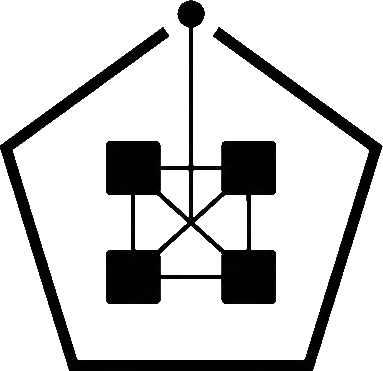
The jail
Part of the security model. Sections keep their original § numbers.
2. The jail
The entire runtime, Scion server, broker, the container runtime, and every agent, runs inside one
isolated machine (an OrbStack isolated Linux guest that shares no host files and has its own
network namespace by default). The lever operator binary runs on the host and drives in. The jail
provides two properties:
2.1 Filesystem: the secrets are not in the environment
An isolated machine shares none of the host’s files by default. Lever opts only the project tree in (a single bind mount). Therefore:
- The broker’s “bind-mount any host path” power is bounded to the project tree, the only directory
the jail can see.
~/.ssh, cloud credentials, the runtime’s own host-side state, and the rest of the disk are not in the daemon’s filesystem at all, so a malicious mount of them fails or comes up empty. - This is removing the secret from the environment, not fencing an attacker away from a secret that is present. No mount-allowlist patch to the runtime is required; the path simply does not exist to mount.
2.2 Network: the LAN is unreachable; egress is allowlisted
Inside the jail, containers that use host networking share the jail’s network namespace, not the host’s. Validated behaviour and its limits:
- The LAN is unreachable. From inside the jail, other devices on the local network (router,
NAS, other hosts) cannot be reached; only the host itself is, via a runtime alias. This rests on
OrbStack’s default routing for an isolated machine (it is not the
--isolate-networkmode, which would also cut the host alias we need for tools), backed by explicit firewall drops so it does not depend on OrbStack routing alone: the allowlist drops the private/special-use ranges unconditionally,10/8,172.16/12,192.168/16,169.254/16(link-local/metadata),100.64/10(CGNAT/Tailscale), and IPv6fe80::/10+fc00::/7(internal/egress/allowlist.go). LAN-unreachability must still be re-checked on OrbStack upgrades. - Host loopback services are reachable via the alias (
host.orb.internal), which forwards to the host’s127.0.0.1over both IPv4 and IPv6. This is how the manager reaches local tool servers (e.g. the broker, an MCP server) without exposing them on the LAN. The alias exposes all host loopback, so it must be clamped.
Network egress: two postures. All lever rules live in a dedicated LEVER_EGRESS iptables/
ip6tables chain that OUTPUT jumps to (never direct OUTPUT rules), so re-apply flushes and rebuilds
only that chain (idempotent, and it never touches non-lever rules). The posture is chosen by the
explicit, jail-wide egress: knob, independent of llm_auth:
egress: open(default):OUTPUTdefault-ACCEPT;LEVER_EGRESSACCEPTs the allowlisted hosthost:ports on the alias, DROPs the rest of the host alias and the private ranges above. Public internet stays open (for the model API and package installs). See the exfiltration caveat in §8.egress: closed: additionally a catch-all DROP for both families at the end of the chain, with loopback (-o lo) ACCEPTed first so the in-machine scion hub (127.0.0.1:8080) and host-alias tools keep working. The jail can then reach only the already-ACCEPTed broker port; arbitrary public-internet egress is closed.closedis valid only for a uniformly api-key instance (a subscription agent needs direct internet to reach Anthropic), enforced at config load.- Reachability under closed egress. With the catch-all DROP, DNS/53 is dropped too, so an agent
cannot resolve
host.orb.internal. Agents therefore dial the broker by its resolved alias IP (already allowlisted), and the broker mints its server cert with that IP as a SAN so TLS still validates (internal/cap/ca/rotate.go NewServerCertSource, which mints viaIssueServerCertSANs;internal/brokerctl/serve.gopasses the IP from$LEVER_HOST_ALIAS_IP, whichinternal/cli/apply.gosets on the broker child). Re-applying a live closed instance detects the active catch-all DROP and skips the flush/rebuild, so egress is never momentarily reopened under a running agent.
Enforcement lives in the jail’s network namespace, for both postures. A non-privileged agent container is in a separate namespace from the rules and cannot flush them; reaching the rules would require a container/namespace escape (which reduces to the kernel/runtime caveats in §8).
2.3 Rootless podman (required)
Scion runs the agents in rootless podman (it auto-prefers podman over Docker; a rootless Docker
daemon is provisioned in the guest too, but the agent containers are podman). Inside an isolated
machine, rootful containers do not work and a rootless runtime is required. An isolated
machine applies a seccomp filter that blocks the bpf() syscall, which a rootful OCI runtime
(runc/crun) needs to program the cgroup-v2 device controller; containers fail with
bpf_prog_query(BPF_CGROUP_DEVICE) failed: operation not permitted. This is the isolation hardening
itself, not a missing capability (the machine has full capabilities; a non-isolated machine
runs rootful nested containers fine). A rootless runtime does not manage device cgroups, so it never
calls bpf() and containers run normally. Rootless is also a security bonus: an extra
user-namespace layer around every agent. On the OrbStack VM’s modern kernel the rootless runtime uses
native overlayfs (not the slow userspace fuse-overlayfs), so the performance cost is small.
2.4 Substrates: the jail is a contract, not a product
Everything above describes OrbStack, but the jail is a contract. A containment backend must
provide a hypervisor boundary between the agent workload and the host kernel (guarantee 0), no host filesystem beyond
the project tree (§2.1), a network namespace Lever controls with egress enforced in it (§2.2), and a
host-reachable broker endpoint. The full contract, the per-backend guarantee matrix, the lima
template mechanism are on the containment backends page. Config
validation rejects any backend name that is not implemented rather than falling back to OrbStack,
so a containment posture is never silently substituted.
Lima operational notes, from the T13 security review:
- Lima’s in-guest kernel attack surface is intentionally widened for rootless runtimes.
Provisioning re-enables the unprivileged user-namespace knob
(
kernel.apparmor_restrict_unprivileged_userns=0) that Ubuntu ≥ 23.10 disables by default, a prerequisite for rootless Docker/Podman’s rootlesskit/pasta. This widens attack surface inside the guest kernel only, in exchange for the rootless containers the whole containment model depends on; the boundary that actually matters — the hypervisor (guarantee 0) — is untouched. An escalation via this surface reaches VM root, not the host, consistent with the §8 “containing runtime authority inside the jail” stance (in-jail privilege escalation is accepted; the jail’s own bound is not). - The jail VM survives host reboots, and also
lever stop. It is destroyed only bylever destroy(limactl delete --force;lever downis a deprecated alias); there is no reboot-triggered teardown.lever stop(limactl stop) merely powers the VM off — its disk is preserved, and the nextlever upresumes it. “Throwaway guest” therefore means per-lever destroy, not per-boot and not per-lever stop— a long-lived instance keeps the same guest state (and any in-guest compromise) across host restarts and stop/resume cycles until explicitly destroyed. - The egress allowlist (§2.2) depends on the VM/rootless boundary above it. Every no-reopen /
allowlist property in this document assumes the agent lacks
CAP_NET_ADMINin the VM’s init network namespace — enforcement lives in that namespace, not the agent’s container namespace (§2.2). A container→VM-root escape would let the agent rewriteLEVER_EGRESSdirectly, bypassing the allowlist rather than merely being contained by it; that escape reduces to the kernel/runtime caveats in §8. - A global lima config can widen the containment surface beyond what the lever template
requests.
~/.lima/_config/{default,override}.yaml, if present on the host, is merged into every lima instance’s realized config, including this one — an operator’s own global lima settings could add a mount or port-forward the lever-rendered template (template.go) never asked for. This is a host-operator supply-chain concern (an attacker would need to already control the operator’s~/.lima/_config, not just the guest), not a guest-exploitable path. The realized-config drift check (Lima.verifyRealizedConfig,internal/backend/lima/lima.go) is the backstop:lever upfails closed if the VM’s live merged config (mounts/port-forwards/containerd) doesn’t match the template’s intent, whether adopting a pre-existing VM or verifying a freshly created one. - Open-posture IPv6 caveat. The alias-scoped ACCEPT/DROP rules (§2.2) are only emitted for a
family whose alias actually resolved;
host.lima.internalis typically IPv4-only today, so under the OPEN posture no v6-specific alias DROP is emitted (there is no resolved v6 alias to drop traffic to). Safe today — the CLOSED posture’s catch-all DROP covers v6 regardless of alias resolution — but if a future lima version or host configuration ever resolveshost.lima.internalto a global-scope IPv6 address, the OPEN posture’s protection depends on that address actually being picked up as the resolvedaliasV6: the unconditional private-range drops (fe80::/10,fc00::/7) don’t cover a global-scope address.make test-lima-e2ecould assertgetent ahosts host.lima.internalreturns no global-scope v6 today, to catch this drifting silently in the future.
The reference-instance trade today (orbstack) is a single shared kernel across the manager and
all workers (§8); lima carries the same trade one level up (its own
kernel is separate from the host, but still one kernel shared within the jail). That trade is a
property of the backend, not of Lever; run lever backends for the live matrix.